
“How to Conference”: Making the most out of farmed animal advocacy conferences
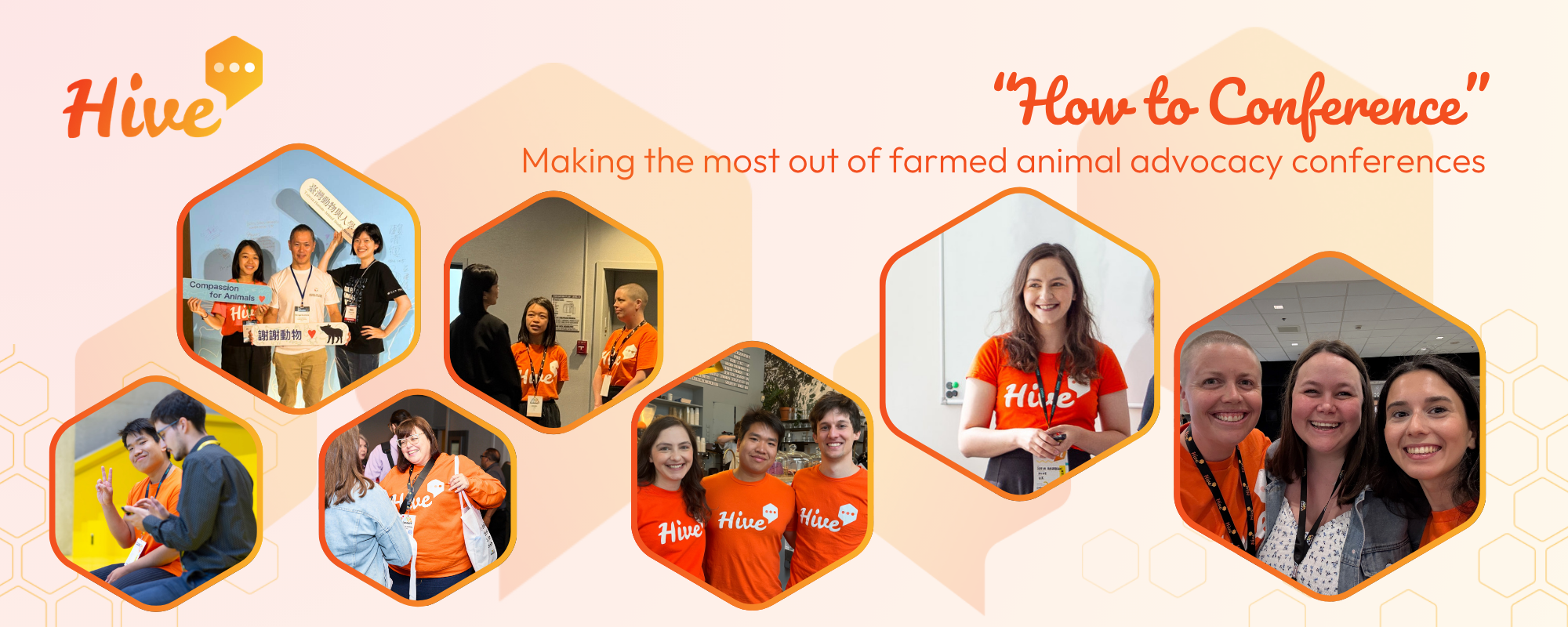
Whether it’s your first farmed animal advocacy conference or your fifteenth: conferences can be energizing, clarifying, and let’s be honest, sometimes a little overwhelming too.
There’s something so uniquely special about spending a few days surrounded by people who care deeply about the same issues you do. Learning together, exchanging ideas, and making new connections can shape your work long after the conference ends. At their best, conferences can spark new collaborations and ideas, and remind you that you’re part of something much bigger than yourself.
But, they can also be intense. Full schedules, new faces, and the pressure to “make the most of it” can leave even experienced attendees feeling stretched.
At Hive, we tend to think that when it comes to conferences, less can be more. Conferences ask for real time, energy, and resources, so it makes sense to choose the ones that are most relevant to your goals, your work, and the kind of advocate you want to become.
With conference season picking up again, we wanted to take a step back and reflect on “how to conference.”
While Hive is a digital home for farmed animal advocates, a big part of our work (and a big source of joy for our team) is connecting with advocates (you!) in person. You'll often find members of our team at conferences around the world, learning about local challenges and figuring out how global connection can amplify efforts in effective animal advocacy.
With AVA Summit Canada, AVA Summit Ghana, and Effective Altruism Global: London coming up around the corner, our team will once again be spread across the globe. This is not unusual for a fully remote team like ours, although conference season does mean we find ourselves dotted across the map differently than usual.
So while there is no single right way to conference, we took some time to gather our own best practices and share them with you. We asked members of the Hive team to contribute their personal top tips and favorite resources. Think of this as a collection of distilled advice you can keep coming back to before, during, or even after your next conference.
Starting the conference right
A recurring theme in our team’s answers was the power of being intentional. Instead of just showing up and following the agenda, the team emphasized creating your own path. That starts with prioritizing what really matters: connection.
“Heavily prioritize one-on-ones. At my first few conferences, I effectively only did sessions, talks, and workshops. This was partially because I was shy, but also because I didn't know one-on-ones were a viable option. I now find that almost all of the value I get is through focused, intentional one-on-one conversations.” — Kevin Xia
“My best tip is to schedule plenty of one-on-ones well in advance. It really reduces stress on site when you already know your schedule, and it also makes it more likely that people still have time for you.” — Therese Veith
“Plan ahead. Instead of arriving without direction, review the participant list, select 5–10 key people you’d like to connect with, and even reach out before the event. This helps you avoid wasting time randomly and ensures truly meaningful interactions.” — Alexia Dean
And for the first day, give yourself some grace.
“I’d recommend not heavily packing your very first morning. It can be intimidating to walk into a brand new space. Give yourself time to absorb the atmosphere and say “Hi” casually instead of jumping into meetings straight away. Getting a feel for the vibes usually makes you recognize that you're not alone in your feelings.” — Nazlı Elvan Gökgöz
During your planned (and spontaneous) 1:1 conversations meet-ups
Once the conference begins, it should be less about how many conversations you can fit into a day and more about the quality of those conversations. In the end, it’s not quantity that matters most, but the relationships you build; relationships that can lead to mutual learning, meaningful collaboration, and sometimes even new projects!
“When you meet new people, instead of asking ‘What do you do?’, try asking things like:
What are your current challenges?
What have you been most excited about lately?
What are you currently exploring?
Listen to the answers and dive deeper. This can help with serendipitous connections and building stronger relationships.” — Sofia Balderson
One thing that the team seems to have learned over time, is that the people you might feel the most nervous to approach are usually more than happy to connect!
“Something I wish I had known is that most people aren’t intimidating at all; they’re usually very approachable. You don’t need to feel out of place, even if you don’t have a big track record yet.” — Therese Veith
“The real value often lies outside the formal sessions. Conversations in hallways or over meals often lead to collaborations that last longer than any single talk. Don’t feel guilty about occasionally skipping a session; the most important things might be happening in those spontaneous interactions.” — Alexia Dean
“A small tip: you can do walking meetings! These are great for getting fresh air, moving your body, and potentially reducing any nervousness you'd feel.” — Angel Lau
During the conference
Conferences are marathons, not sprints. If you try to do everything all at once, you’ll burn out. The team emphasized the importance of setting boundaries and prioritizing your own well-being.
“Maintain healthy boundaries and monitor your energy level. Don't feel pressured to attend absolutely everything (meetups, 1:1s, pre- and post-parties). It’s okay to step back.” — Angel Lau
“There's nothing ‘wrong’ with sitting alone or wanting to be alone during the conference. It's very easy to feel FOMO, but you should prioritize your personal needs.” — Nazlı Elvan Gökgöz
After the conference
The work isn’t done when you return home. Often, what separates a good conference from a truly great one is what happens afterwards: capturing insights, following up with intention, and carrying the conference’s momentum back into your work.
“Intentionally block out time after a few meetings to gather your notes and thoughts, instead of letting the day become one endless stream of conversations. I often tidy up my notes when I get back to my room, then use AI tools to help synthesize and categorize them. It really helps make sure nothing valuable gets lost in the post-conference whirlwind.” — Nazlı Elvan Gökgöz
Our Team’s Go-To Reading List
Finally, we’ve collected a handful of resources that our team members share repeatedly.
For First-Timers: How to make your first EAG a success by Sofia
For Avoiding Burnout: How to enjoy a conference without burning out by Sofia
For a Deeply Practical Approach: Tacit Knowledge: How I exactly approach EAG(x) conferences by Gergő and Get organised for EAG: use Google Calendar for meetings by Sofia
For Making an Ask: Tips for asking people for things by Ben
For Everyone: Your conference will likely send out an “All-you-need-to-know” type of document; make sure to read it thoroughly!
Ultimately, there's no single right way “to conference”. These are just some of the heuristics approaches that help our team navigate them. We're still learning, too!
What's the one tip you'd add to this list? We'd love to hear it. Comment to share 🧡
