
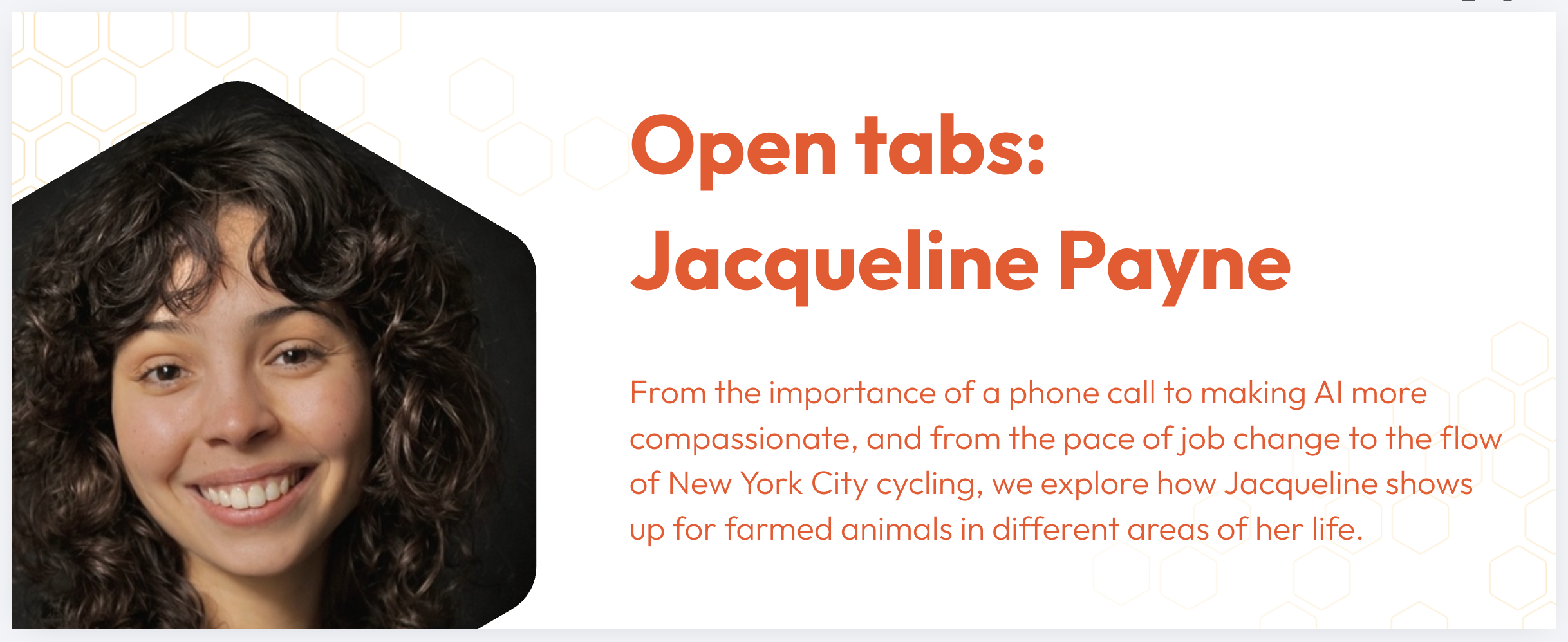
Open tabs: Jacqueline Payne
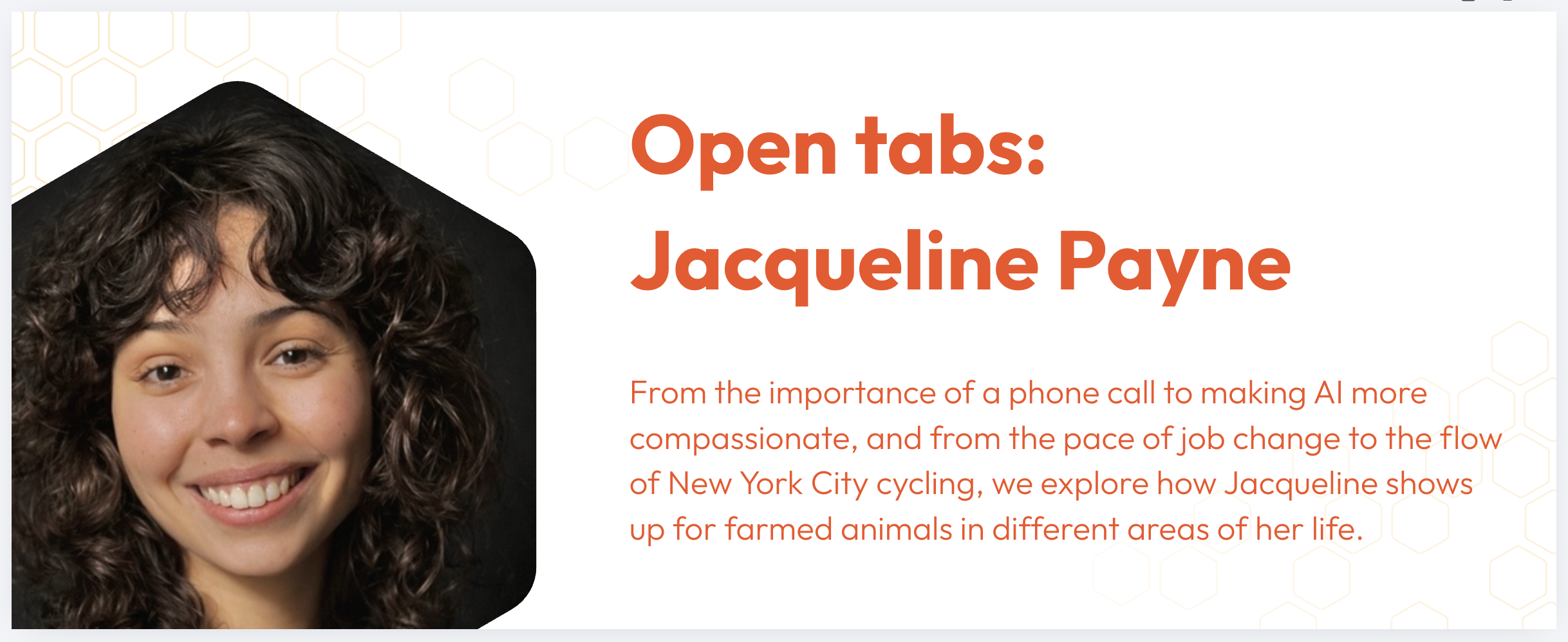
With the Open tabs series, we introduce you to members of Hive’s CoNectar monthly giving community. You’ll get a behind-the-scenes window into what they’ve been paying attention to lately in the world of farmed animal advocacy, and how they’re taking action in a way that fits their circumstances.
In our first edition, I got to catch up with Jacqueline Payne. We explored her journey into veganism and caring about farmed animals, advocacy when time is (very) scarce, her career pivot towards the AI x Animals intersection, and what she avoids giving her attention to.
What struck me about Jacqueline is how she learns about something and then takes decisive action. It can be easy to get stuck in analysis paralysis or perfectionism, and Jacqueline’s persistent forward momentum is something I found deeply inspiring. I hope you enjoy our conversation as much as I did!
This interview has been lightly edited for length + clarity.
Megan: I want to start with the beginning. Was there something in particular, like a conversation, organization, an experience, or a piece of content that really sparked your compassion for farmed animals? Or was it more of a gradual change in your worldview?
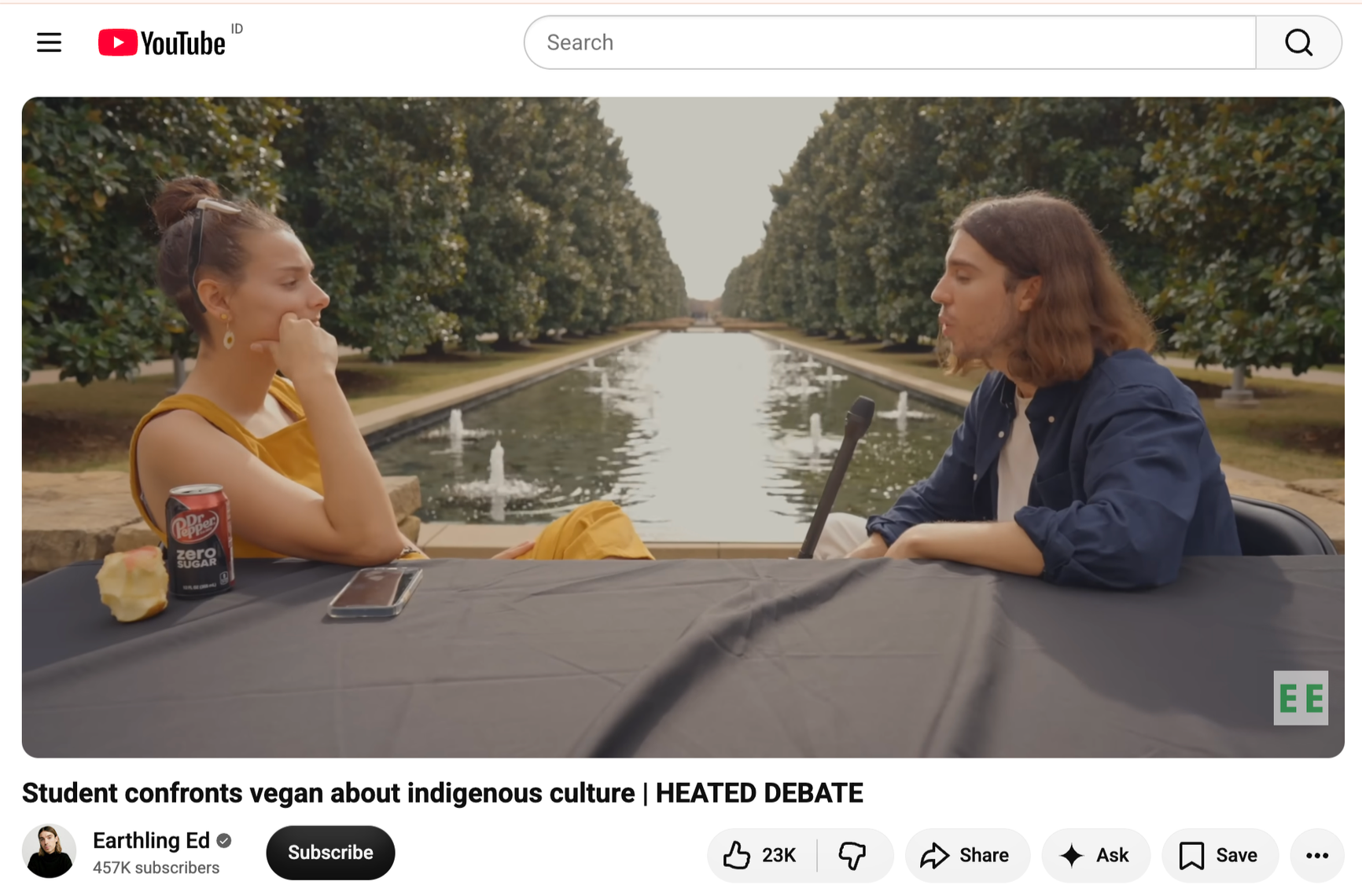
Jacqueline: It was pretty sudden. In 2021 I had COVID for the first time and was in isolation, watching a lot of YouTube videos. At some point, the algorithm recommended Earthling Ed’s college debates.
I was already vegetarian and aware of animal welfare concerns. But I think those videos really showed me how much further I needed to go. I immediately decided to switch. It was December so I thought, “okay when it’s New Year’s Day, I’ll become vegan.” That was four years ago.
Megan: Wow, what a cool rabbit hole to jump down during COVID.
Jacqueline: I have a friend that likes to say that I got radicalized by YouTube. Obviously it’s a joke, but I just think it’s very funny. I don’t know why the algorithm decided to recommend the college debate videos, but it worked. Earthling Ed structures them in a way that people get confronted with their own cognitive dissonance, and obviously that worked on me as well.
Megan: You have a full life with limited hours for everything else you care about. How do you decide where to put your time and attention these days when it comes to animal advocacy?
Jacqueline: I’m currently struggling with time management. I’m a software engineer and I want to switch to technical AI safety. So, balancing work and a career switch already requires a lot of my time.
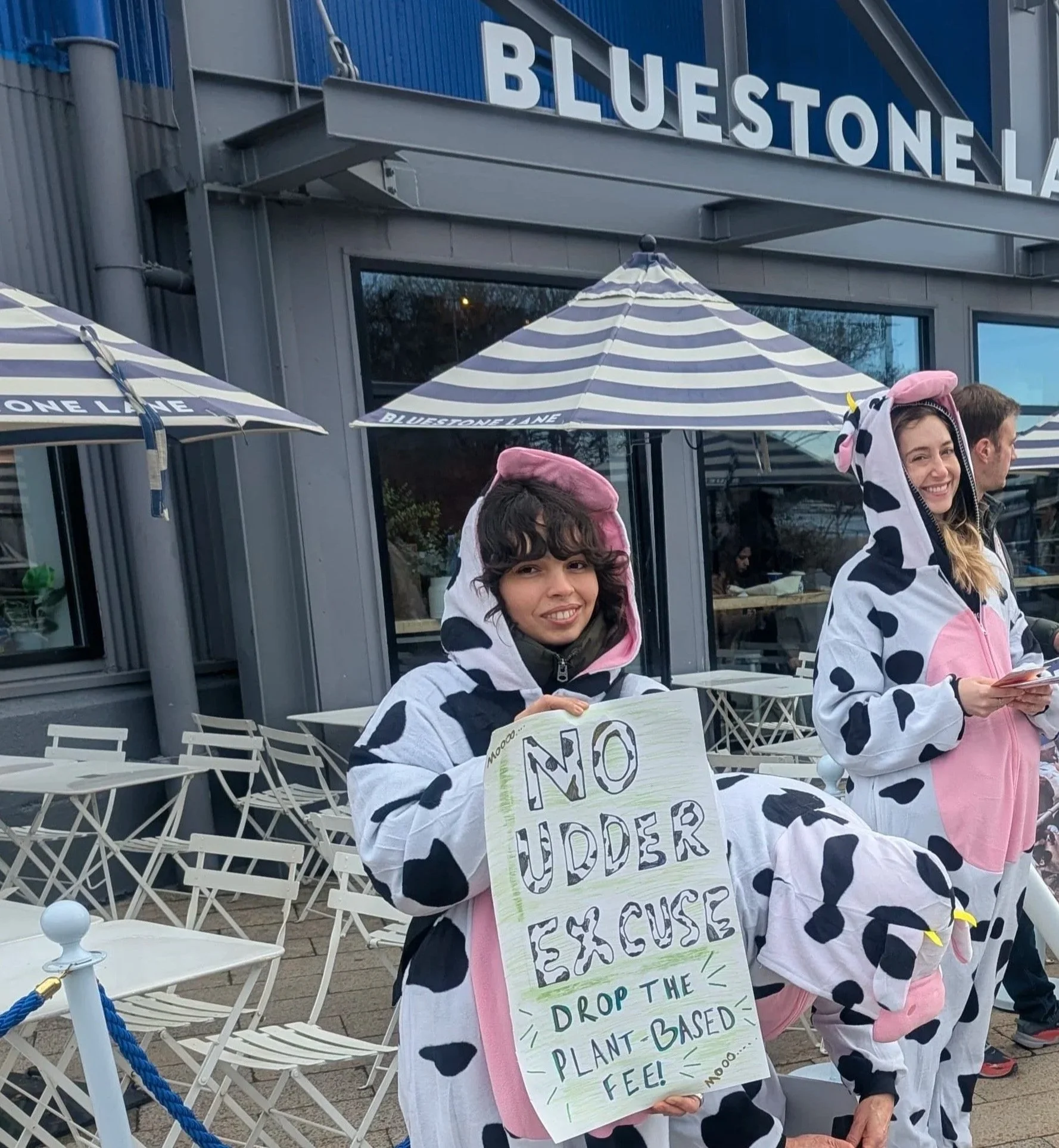
But I want to make sure I still put some of my time towards animal welfare. What I do is try to attend a protest here or there in New York City where I live. If there’s an anti-fur protest or cage-free protest, I just try to show up if it’s not during work hours.
Another thing I’ve been trying to make time for is calling my representatives in the Senate and House of Representatives. A big focus for us in the U.S. right now is trying to ensure the Save Our Bacon Act is removed from the Farm Bill.
I’ve seen how certain actions can be very time-sensitive and potentially very impactful. So I try to put at least some time towards that, within all the other constraints like working full-time and also wanting to switch my career and still having a social life.
Megan: You’re balancing a lot. It’s awesome that you make time to show up for these actions.
Jacqueline: Yeah. I can’t do as much as some other people I know that I’m so impressed by, like the people that show up to every protest. I love that. I wish I could do a little bit more. But as long as I try to do a few things, I try to stay focused on what I am doing. It’s something.
Megan: What does staying connected to the movement actually look like for you week to week? For example, what social media platforms do you check? What do you read? What do you skip?
Jacqueline: The biggest way I stay connected is WhatsApp groups for local events in and around New York City. I find that helpful. I actually try to avoid social media because I feel the shortform videos are very addictive. Most of the time, my apps are blocked–Instagram, YouTube, even LinkedIn. But staying connected via WhatsApp helps a lot with knowing what protests or events are coming up.
Megan: The apps are addictive by design, no shame in having guardrails.
Megan: You give to Hive and you’re one of the people that makes our community possible through your support. From your perspective as a donor that considers animals in their giving decisions, what kinds of projects in the farmed animal movement are exciting to you these days?
Jacqueline: With everything going on for me right now, I haven’t been as connected to new projects. But I do think we could make huge strides in policy, and that’s something that’s surprised me.
When I was getting more directly involved with taking volunteer actions with The Humane League and Mercy For Animals, I was surprised at how much an individual could do by talking to their own government officials. That’s why I think this is a good area to stay focused on.
Megan: It’s interesting, we’ve twice touched on taking action for farmed animals through calling government officials. Like you say, sometimes these things can have an outsized impact compared to the effort they take. On paper, a phone call takes five minutes. But I also sometimes wonder if getting on the phone just feels hard for a lot of people.
Jacqueline: I’m one of those people that it’s hard for. I get at least a little bit of anxiety, like if someone actually picks up, how do I respond? Most of my calls recently have gone to voicemail. I don’t know if it’s just the younger people like Gen Z who are scared to call people.
Megan: I think it’s just a muscle you build. I’m a Millenial, it’s hard for a lot of us too. I guess an upside here is that if a lot of people struggle to make a phone call, it can matter more when we actually do make that effort, even if the call feels a little awkward. It can matter more than sending a message on social media.
Jacqueline: For sure. But I also do that, messaging my representatives like the Mayor of New York City on Instagram when I’m online, trying to get them to pay attention to animals.
Megan: Nice, using all the tools in the toolkit.
Megan: This is a big question. Because of your work in software engineering, you’re closer to AI than a lot of people in the space professionally. How are you thinking these days about what AI might mean for animal advocacy? What are you paying attention to?
Jacqueline: My personal theory of change for AI and animal advocacy is to become an animal-inclusive AI researcher or research engineer.
So much AI research asks how AI affects humans, and never asks, well, what about everyone else? I want to understand the biases that current research isn't considering, the ones that leave animals out, and help address that from the inside.
I think the personalities that AI models have right now are constructed to a significant extent by each lab. That means we can make a difference in how each model responds, by making them more compassionate.
Megan: AI is a big topic in the animal advocacy movement these days, but it’s not everyone that decides to make a career pivot based on this. I think that’s an admirable and challenging thing to do. Do you remember when you made the decision?
Jacqueline: I remember starting to think seriously about it in October. I’d gone to EA Global: New York City. I’d met a lot of people working in AI there. Those conversations led me to thinking more about my future.
Then I did the BlueDot Impact AGI Strategy Course. I’d already had an awareness of where AI could go wrong, but the course helped me explore all the specific arguments. That experience showed me that this is a problem I should probably work on.
But, I still care about animal welfare, it’s my number one priority. That’s where the Electric Sheep Fellowship came in. I was able to learn more about the intersection between AI and animals. It was around this time that I realized I should probably quit my job.
In March, my company had 30% layoffs. I survived, but they started pushing AI more. My job changed a lot, and quickly. This already felt really fast, and there’s so many things in the future that could change even faster with AI than what I experienced. That got me moving.
Now, I’m doing an alignment research bootcamp in the UK. After that, I plan to leave my role. The thing is, I need to make time somewhere and the biggest time sink is my job. When I’m working, I like to do great work. That takes a lot of time, especially when the company now has less engineers. I have some savings to hold me over between roles, so I’m going for it.
Megan: This might not be the best time to ask this question, but I’d wanted to know what brought you to software engineering in the first place? What do you like about it?
Jacqueline: Yeah, it’s funny to think about this question because lately I’ve been feeling like I don’t want to be in my role anymore. I used to really enjoy software engineering before Claude Code came out. I found I was pretty good at it, at solving problems and taking the time to understand architecture and planning.
You can get into a flow state, and that’s what attracted me to software engineering back when I was a business major in college. I’d never coded before. In one of the business classes we had to make an HTML website, and I enjoyed it. I was unhappy with the job prospects for my business degree and coding came fairly easily to me. So I switched.
Software engineering has been a very good trajectory to pursue. Even though AI has really changed things, we still need people who understand code.
Megan: Taking a step back, although the specifics of your situation are pretty unique, the general trend is much more common: To be committed to a better world for animals alongside a bunch of other life responsibilities. So I’m wondering, what advice would you give to someone reading this who is in a similar position to you?
Jacqueline: I put a lot of pressure on myself. I think a lot of people do, they set goals and then pressure themselves towards those goals. But I think it’s good to give yourself a break sometimes. Usually, you are your own biggest critic, not external people.
Megan: One thing that’s core to Hive is the belief that everyone can make a meaningful contribution to farmed animal advocacy in a way that fits their circumstances. And as you know, our community members do that in so many ways. With their time, money, skills, actions. There’s endless ways to show up. At the same time, we’re usually using terms like “advocate” and “advocacy” to describe these people and what they do. With this context in mind, do you identify with the word “advocate” to describe yourself?
Jacqueline: Yeah, I’d say so. I guess I’d say vegan first and then advocate second, but I think advocate is the broader term and that we should be widening the umbrella so that it’s not just vegans. It’s going to be hard if it’s just us vegans fighting for farmed animals.
So yeah, I’d definitely say I’m an advocate for farmed animals.
Megan: We touched on this earlier with the NYC WhatsApp groups and events you participate in. I’d love to know more about your in-person community that shares these values with you.
Jacqueline: When I first went vegan, my like-mind community was mostly online. Then I moved to New York. There was a point where I decided that I needed to meet more vegans so that I don’t feel so alone. Eating dinner with other people who aren’t vegan, it really shows you that what you’re doing is strange in the eyes of other people.
So I started to meet more vegans in the community. The Effective Altruism NYC group was one way I did this. I slowly got invited to other events and built up from that.
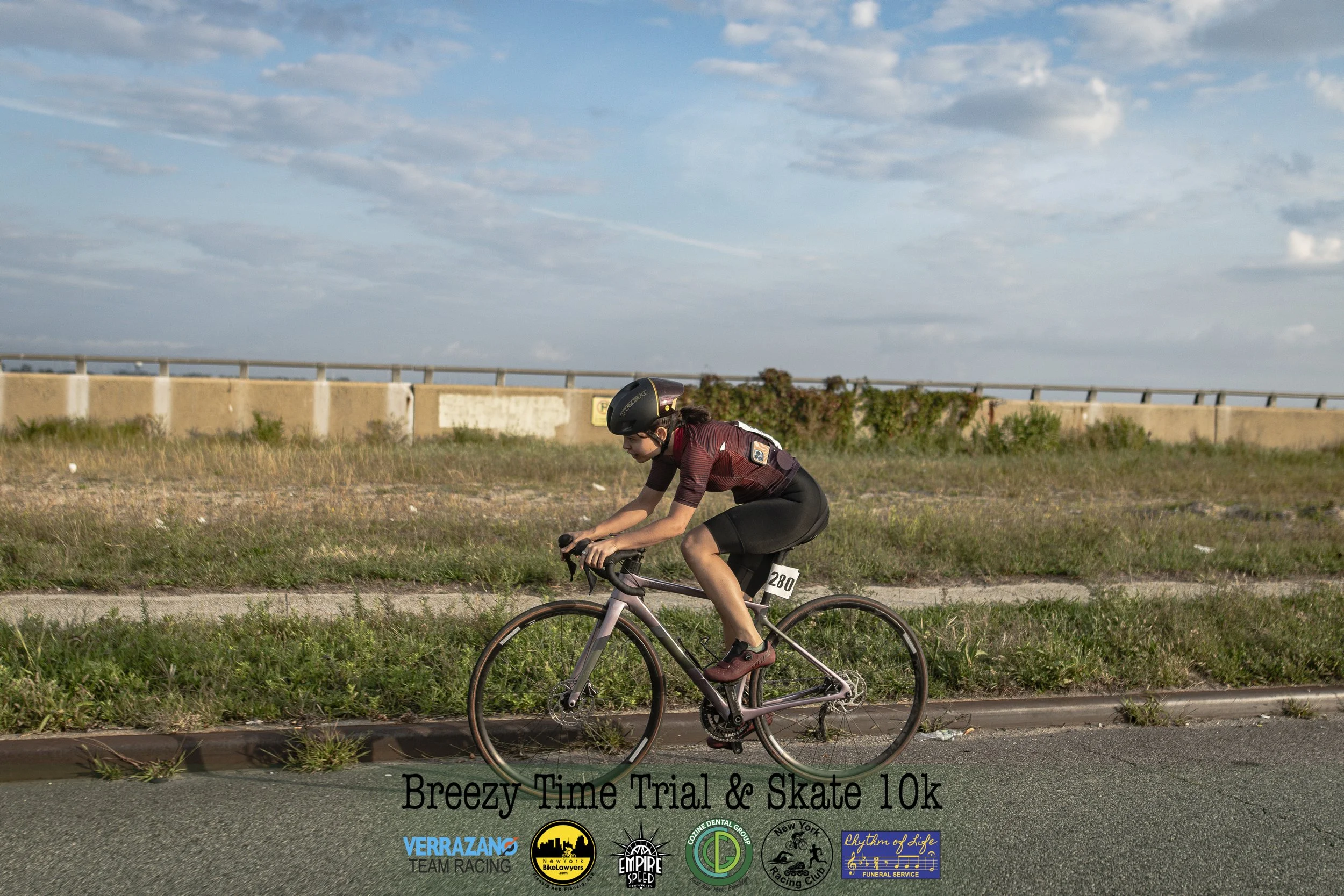
Megan: Glad to hear. Moving towards wrapping up now, let’s end with a few (hopefully) lighter questions. You’re an avid cyclist. Is cycling a space where you reflect and come up with ideas, or are you spending most of your bandwidth navigating hectic New York traffic?
Jacqueline: I have a bit of a funny answer that’s kind of neither of those options. I try to be very safe when I ride in NYC because I want to reduce the probability of hitting a car or a person. So I usually take protected bike lanes or ride in Prospect Park. It’s a lot of fun to ride there.
So it’s not focused on traffic but I’m not necessarily coming up with ideas either. It’s more about just getting into a zone. In my day-to-day I’m spending so much time thinking. I’m always planning the next thing or mentally reviewing my to-do list, or thinking about the news.
Cycling is my time to stop taking in new information and just focus on pedalling, on the world in front of me, on being where I am. I think that's just a very nice thing to do sometimes.
Megan: We all need time away from new information, we need some time and metabolize it all.
Jacqueline: Exactly. The information landscape is so overwhelming. I’m trying to figure out how to reduce notifications all the time.
Megan: We’ve got a few quickfire closing questions. First up, remote or in-person work?
Jacqueline: Remote every time. I’ve only ever worked remotely!
Megan: Typing, handwriting, or dictating notes?
Jacqueline: Typing.
Megan: Tofu or seitan?
Jacqueline: Tofu. I like seitan but tofu is just so amazing. It’s so versatile.
Megan: Coffee or tea?
Jacqueline: Tea, but I’ve unfortunately gone back to coffee lately, after drinking tea for 2 or 3 years without any coffee.
Megan: I’m going to write this one down as tea.
Thank you so much Jacqueline for building a better world for farmed animals, and for taking the time to share your story with me and the Hive community! 🧡
A few resources Jacqueline mentioned
Earthling Ed: Substack.
EA Global: View upcoming events around the world.
BlueDot Impact: Upcoming courses.
Electric Sheep: Upcoming fellowships.
Effective Altruism NYC: Website.
